A little boy collecting twigs. Two children playing at the water’s edge. We’ll start with a photograph, then enjoy the colour, marks and texture that make it a painting of our own.
Worried about drawing? There are ways to help you begin. We’ll work with simple proportions, and use photo cut-outs in the beach project.
Two main paintings + a bonus studyReference photos includedAt your own paceEnglish voice · French & Dutch subtitles
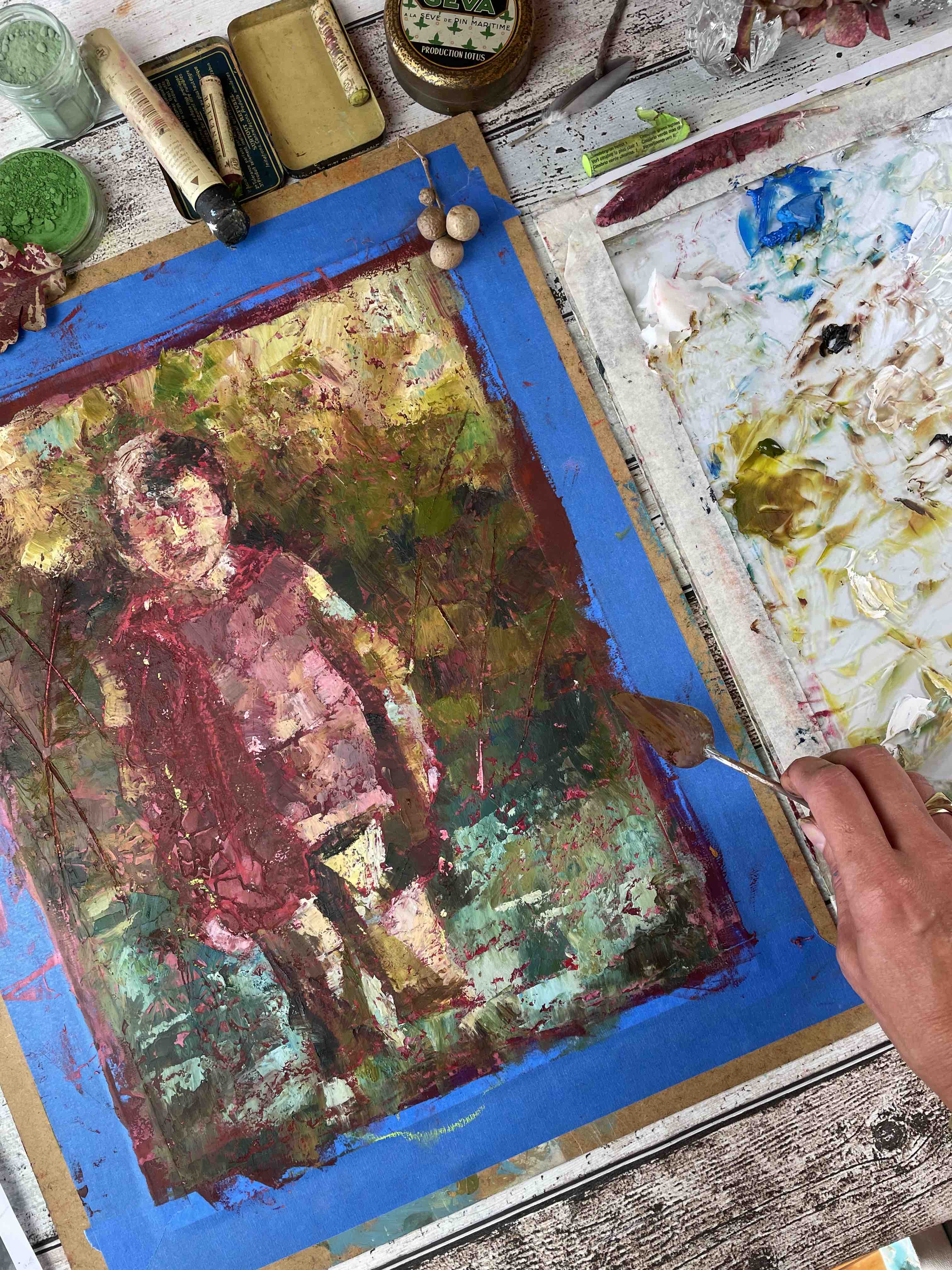
The Twig Collector, on my painting tableMake it your own.
If drawing is holding you back
You don’t need a perfect drawing to begin.
We’ll look at a child’s proportions and try a few loose drawing exercises. The tilt of a head, the bend of a knee, the way a little hand holds something. Those bigger shapes tell us a lot.
For the beach painting, I cut the figures out of the reference photo and use them as masks. They keep the children’s places while we work on all the lovely colour and texture around them.
You can use my photographs or bring one of your own. Change the background, try different colours, leave a detail out. We’re making a painting, not copying every part of a photograph.
We’ll follow two main projects, with different ways to bring the children and their backgrounds together. There’s a little blue study to try afterwards, too.
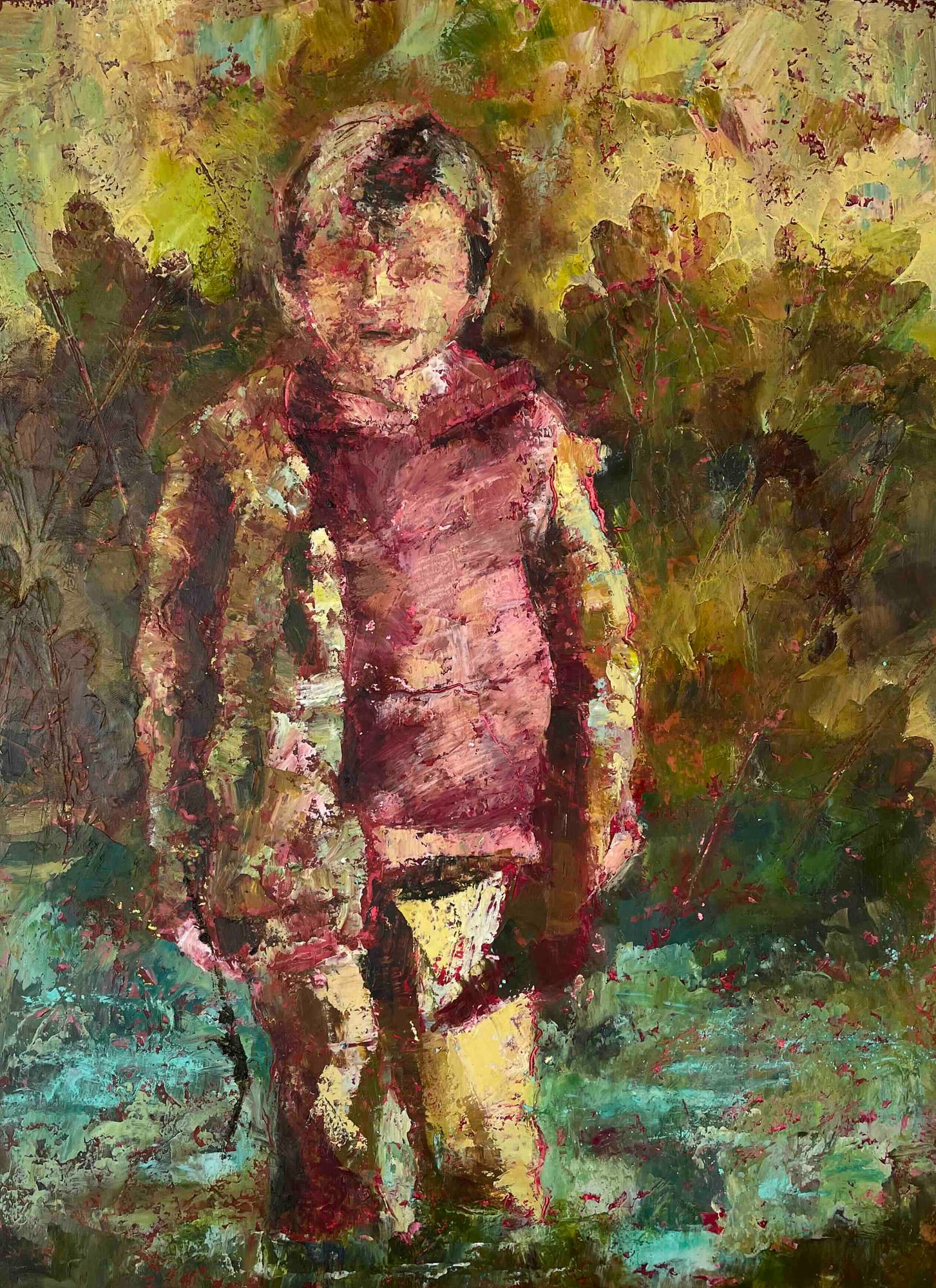
The Twig Collector
Main project 1
A little boy, a handful of twigs.
We paint on paper, using a palette knife to build colour and texture. Real leaves become masks, and small touches of colour help connect the boy with his surroundings. There’s so much to enjoy in the background, too.
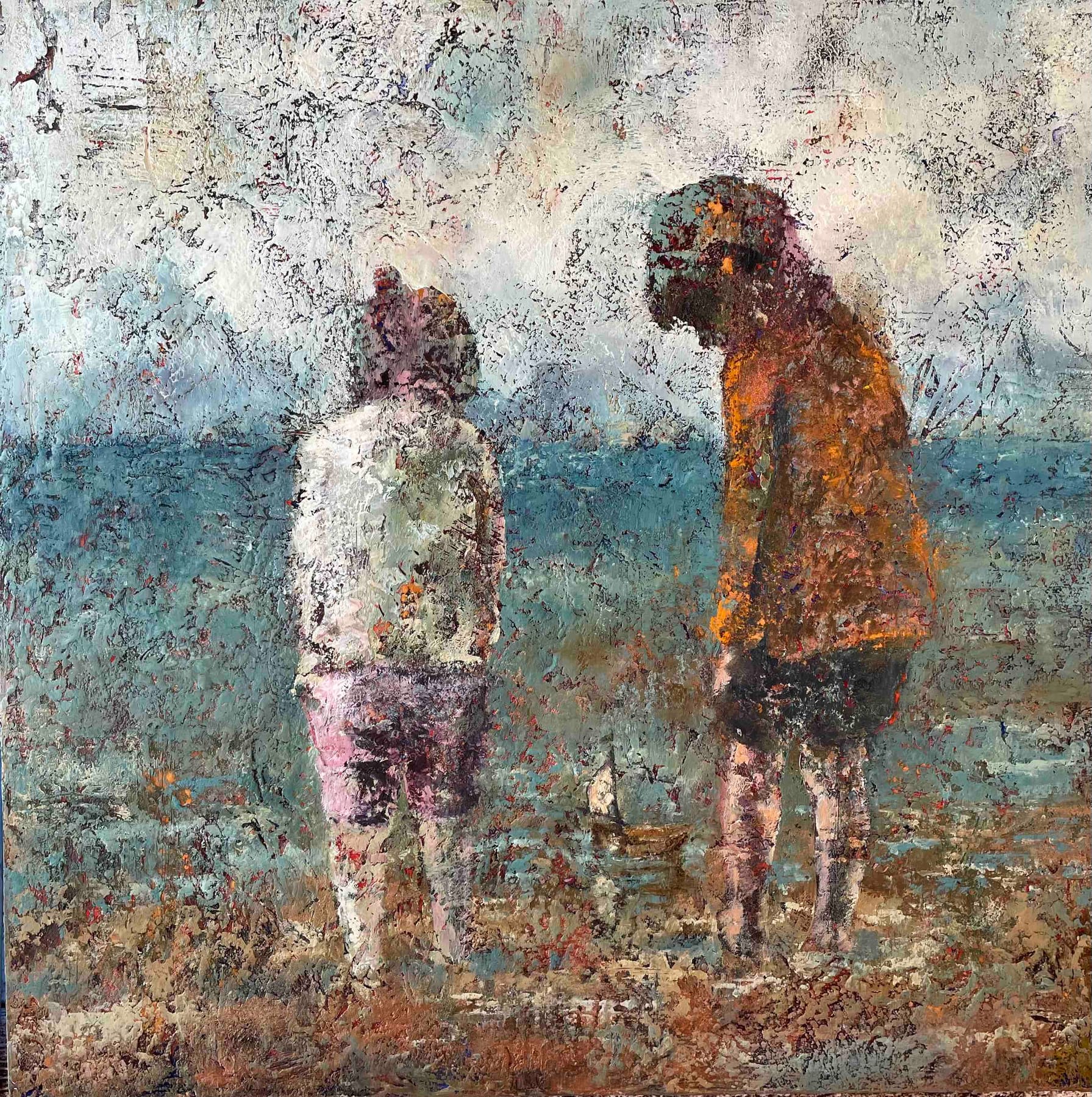
On the Beach
Main project 2
Bare feet, a boat and all those layers.
We cut out the figures from our reference photo and use them as masks while we build the background. Then we paint the children into the scene, working with the colours and marks around them. Keep the beach or imagine somewhere else.
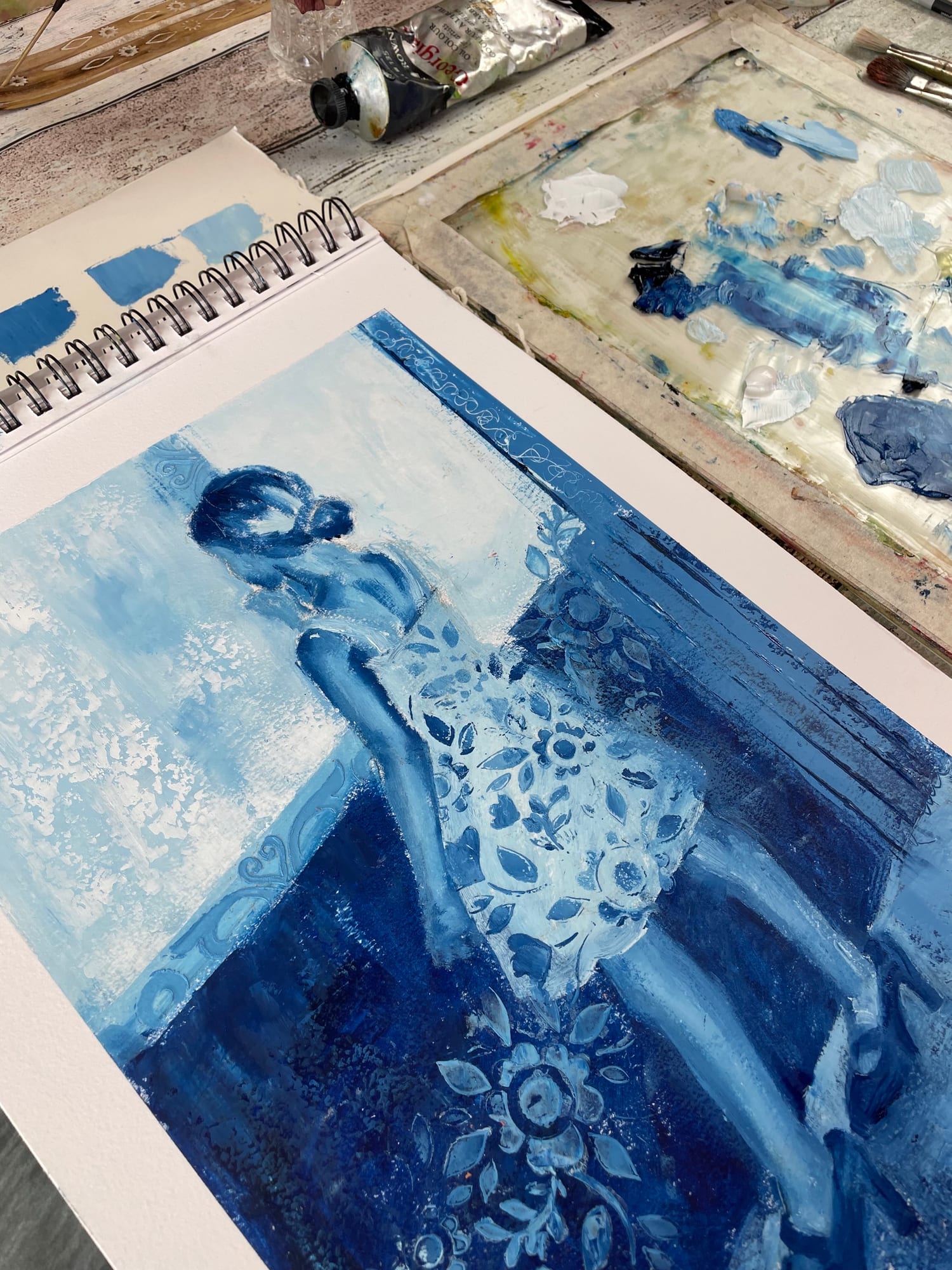
A Little Girl in Blue
Bonus study
See what one colour can do.
A smaller study to explore lights and darks without a whole palette to think about. We paint a little girl in shades of blue, keeping the marks loose and seeing how much we can say with a few shapes.
You can follow my painting, but it doesn’t have to look like mine.
A little look inside
Come into my studio.
Have a look at the paintings and what we’ll be exploring together.
Paintings from the class
Their stories. Their colours. Their paintings.
I love seeing where students take these ideas. Different photographs, different stories and so many lovely ways to use the layers.
After the welcome and supply guidance, four modules take us from simple proportions and warm-ups into the two main paintings. Watch a part, try it, and come back when you’re ready for another layer.
A warm-up, not a perfect drawing
01Proportions of a childA few guidelines to help you see the shapes
We look at how a child’s proportions differ from an adult’s. Using reference photos, we find the main shapes and how they fit together. These are useful starting points, not a test in perfect drawing.
02A little drawing warm-upLoosen up before we get the paints out
Try drawing without looking down at your paper, keeping your line moving, and working from an upside-down reference. These playful exercises help us look more closely and worry a little less about making a neat drawing.
03The Twig CollectorColour, a palette knife and some real leaves
Follow the painting on paper from the first layers to the finishing marks. We build up texture, use leaves as masks and bring small touches of colour from one area into another. You can follow my colours or try your own.
04On the BeachPhoto cut-outs, textured layers and two little figures
We prepare cut-out masks from the reference photograph and use them while building the background. Then we develop the figures and their surroundings together, deciding which marks to keep and which areas need another layer.
And a little extra: A Little Girl in Blue
A monochrome painting study to explore light and dark with a simpler palette.
Hello, I’m Marina
The little boy is my son.
He’s grown up now, but in the photograph for The Twig Collector he’s still that little boy, busy gathering his sticks. I loved returning to that moment through paint.
And I loved making it something different from the photograph. A red coat, touches of turquoise, leaves used as masks. That’s the part I want to share with you.
You might have a photograph you’ve been wanting to paint for years. Or perhaps you just like the beach scene and want to have a go. Both are lovely reasons to begin.
I would love to paint with you. Marina x
A photograph, some paint and a place to begin
Shall we paint a little moment?
Choose your colours, put a few tools on the table and paint along with me. You don’t have to know how the whole painting will turn out.
Painting Children
Cold Wax & Oils · Full online class
$99One payment. No subscription.
Simple proportions and playful drawing warm-ups
Two main paintings + A Little Girl in Blue
Four teaching modules and reference photos
Lifetime access, at your own pace
French and Dutch lesson text & subtitles
Email Marina when you have a question
Creative Spark cards from the Texture Lab
The Texture Lab
Would you like to keep painting with me?
An online painting membership for texture lovers.
This Children class is also included in Texture Lab Gold and Inner Circle. Paint along with this class, try other projects, open the online magazine and share what you’re making with other members.
Buying the class separately gives you lifetime access. Access through Gold or Inner Circle lasts while your paid membership is active.
A few things you might be wondering
Before we get the paints out.
I’m not confident drawing children. Is this for me?
You don’t need a polished drawing to begin. We look at simple proportions and try loose drawing exercises, with reference photos to help us. In the beach project, I use figures cut out from the photo as masks. There is some drawing in the class, but the focus is on making a painting with colour and texture, not getting every little detail right.
Do I need to know how to use cold wax and oils?
Some familiarity with the medium is helpful. The class includes a welcome and supply guidance, but its main focus is painting children. If cold wax is completely new to you, I recommend beginning with my getting-started videos or Cold Wax & Oils: The Basics.
Can I use a photograph of my own child or grandchild?
Yes, and you can also work from the reference photos supplied with the class. You don’t have to paint someone you know. Choose an image that interests you, then change the colours, the background or the little details if you like. The photograph is a starting point.
What materials will I need?
Cold wax medium, oil paints and a suitable painting surface, such as oil painting paper or a prepared wooden panel. We use tools including a palette knife, scraper, brayer and small brushes. Look through the supply guidance before shopping; there are optional materials and you don’t need to buy every tool I use.
Could I explore these ideas in acrylics?
The ideas about colour, shapes, layers and simplifying a photograph can inspire your acrylic painting too. The demonstrations in this class use cold wax and oils, though. The materials and drying behaviour are different, so this isn’t an acrylics technique class.
Do I have to set aside a whole day?
No. Watch a part, try it on your own painting and come back when you’re ready. Some stages need drying time between layers. There’s no timetable to follow and no deadline to finish.
How long can I watch the class?
Buying the class separately gives you lifetime access for one payment. You can repeat the lessons whenever you like. It’s also included in Texture Lab Gold and Inner Circle, where access lasts while your paid membership is active.
Is the class available in French or Dutch?
Yes. French and Dutch lesson text and video subtitles are available. My spoken teaching stays in English. The short introduction on this page is in English too.
 The Twig Collector